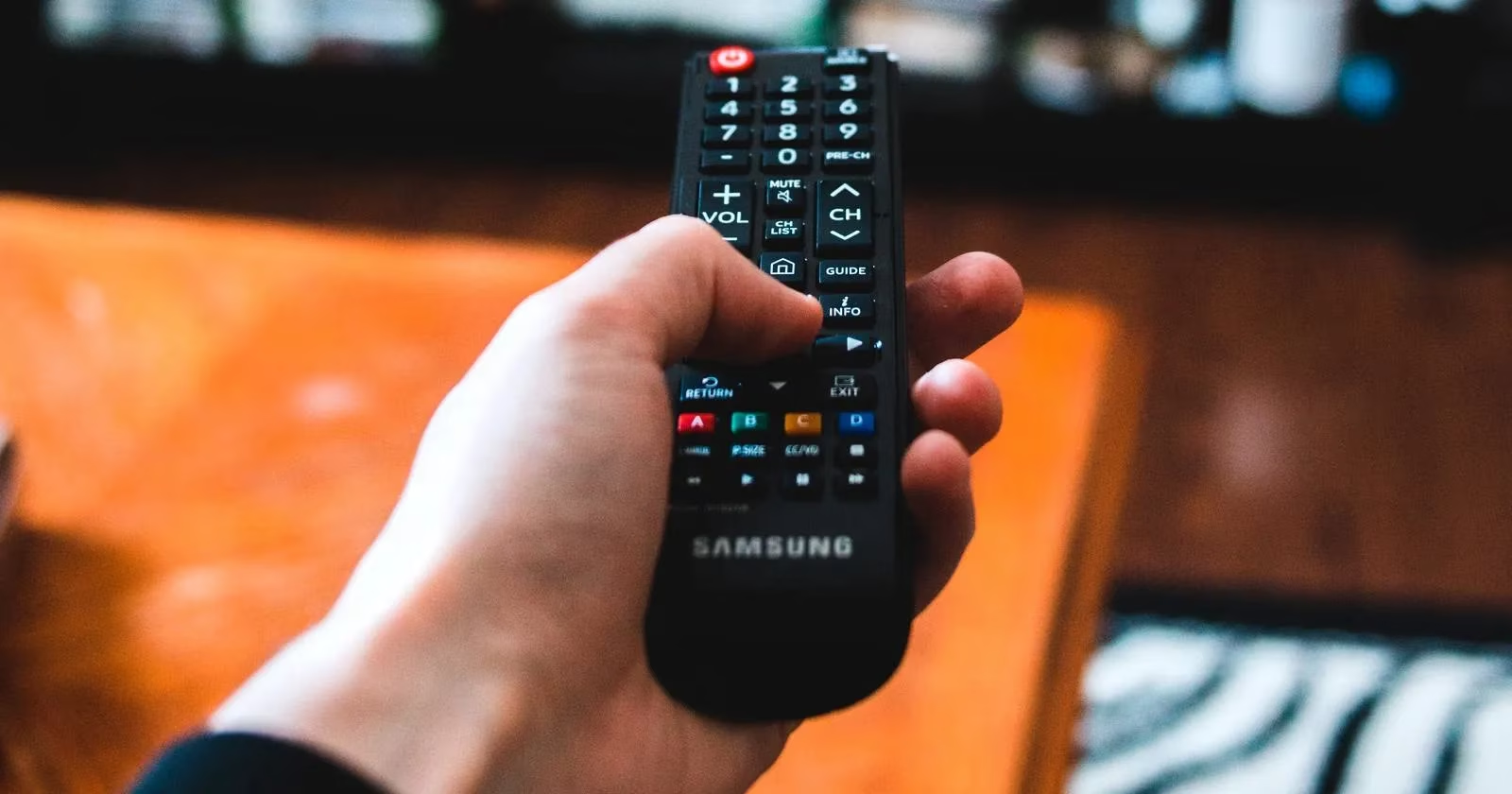
Remote controls remain one of the most familiar pieces of consumer electronics in 2026. From televisions and air conditioners to garage doors, drones, and smart-home hubs, these hand-held devices let users issue commands from a distance. The basic design has not changed dramatically: a remote control is a small electronic unit that communicates with a receiver inside the target device. The transmitter sends an encoded signal, and the receiver decodes and executes it. That simple exchange still powers millions of daily interactions.
🧩 What Is Inside a Remote Control?
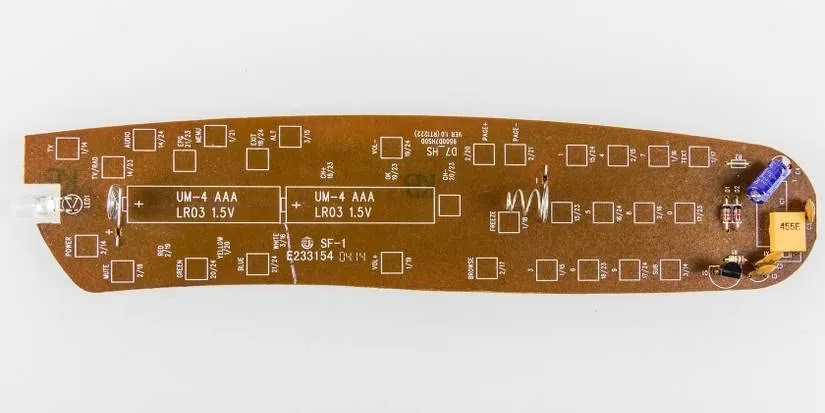
Inside a typical remote, three core parts stand out: buttons, an integrated circuit board, and batteries. The buttons are often rubber, with a thin conductive layer of graphite on the back. Pressing a button completes a circuit and inputs a command. The printed circuit board detects the press, processes the command, and translates that key into a unique signal sequence. A programmed integrated circuit, power connectors, transistors, and a transmitter module sit on the board. The transistor amplifies the signal, and the transmitter module sends it as infrared light or radio frequency energy.
| Component | Function |
|---|---|
| Buttons | Input commands through a conductive graphite layer |
| Circuit board | Detects presses, processes commands, and creates signal sequences |
| Transistor | Amplifies generated signals |
| Transmitter module | Sends signals as IR light or RF waves |
| Batteries | Provide 1.5-volt power for the circuit |

Power usually comes from one or two 1.5-volt batteries. Capacitors draw energy from the batteries into the circuit, and the circuit is completed when a button is pressed. That moment of contact is what turns a simple press into a coded instruction.

📡 Two Main Types: IR and RF
Remote controls generally fall into two technical families: infrared (IR) and radio frequency (RF). Each has strengths and weaknesses, and both remain relevant in 2026.
| Feature | IR Remote | RF Remote |
|---|---|---|
| Signal type | Infrared light pulses | Radio frequency waves |
| Line of sight | Required | Not required |
| Range | Short | Up to 100 feet |
| Obstacles | Blocked by walls, smoke, fog, sunlight | Works through walls and physical obstacles |
| Cost | Lower | Higher |
| Power use | Lower | Higher |
| Interference risk | Low | Possible from other devices |
🔴 Infrared (IR) Remote Controls
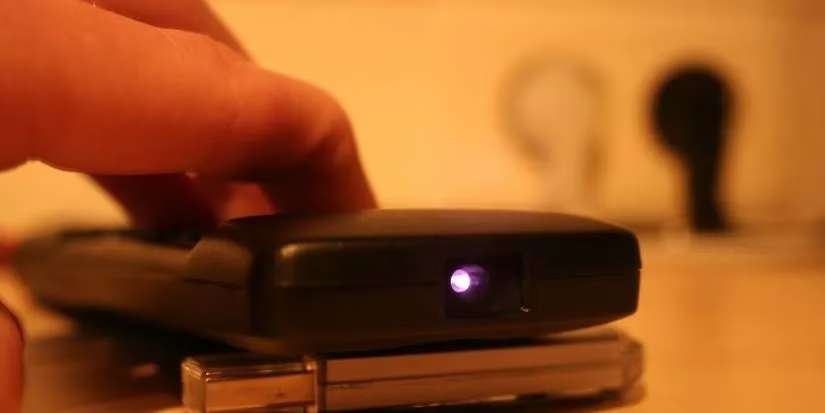
IR remote controls use infrared light to transmit commands. They require line of sight, so the user must point the remote at the device. IR LEDs at the end of the integrated board emit pulses of infrared light. Those pulses are binary codes generated when buttons are pressed. The IR receiver in the target device picks up the light, decodes the command into binary data, and passes it to a microprocessor. The microprocessor then executes the action.
IR remotes have notable advantages:
-
They are cheaper and more readily available.
-
They provide secure point-to-point communication.
-
They use less power, so batteries last longer.
-
They are stable over time.
-
They are difficult to intercept.
Their disadvantages include:
-
They cannot function effectively over long distances.
-
They require line-of-sight communication.
-
They can fail around hard objects, smoke, fog, and sunlight.
📻 Radio Frequency (RF) Remote Controls
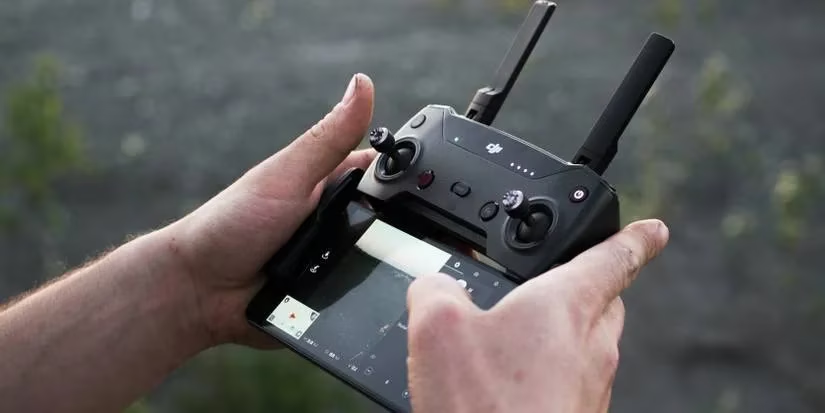
RF remote controls use radio frequency waves to control devices. They are commonly used for distant objects such as electric gate openers, drones, garage doors, burglar alarms, automatic barrier systems, and industrial automation systems. An RF transmitter module sends radio frequencies after the integrated circuit generates the command. Because radio waves can pass through walls and other obstacles, RF remotes do not require line of sight. They can also work over long distances, often up to 100 feet.
RF remotes offer clear benefits:
-
They work well over long distances.
-
They function through walls and physical obstacles.
-
They do not need a line of sight.
But they also have drawbacks:
-
They are more expensive than IR remotes.
-
They may experience radio frequency interference from other devices.
🚀 Remote Controls in 2026
The remote control market has grown more diverse by 2026. Streaming boxes and smart TVs often use Bluetooth remotes, which pair like wireless accessories and do not need line of sight. Smart-home systems may rely on RF, Zigbee, Thread, or Wi-Fi. Voice assistants and smartphone apps have also become common control layers. Even so, IR remains widespread in air conditioners, older televisions, and budget electronics because it is inexpensive, stable, and secure in point-to-point use. RF continues to dominate applications where distance and obstacles matter, such as gates, alarms, and industrial equipment.
For users, the appeal is unchanged. Remote controls offer fingertip control and the ability to manage several gadgets efficiently. A person does not need to walk to a television to switch channels or climb up to an air conditioner to adjust its temperature. The remote handles those tasks from across the room. In 2026, whether the signal is IR, RF, Bluetooth, or Wi-Fi, the underlying idea remains the same: a transmitter encodes a command, and a receiver acts on it. That principle continues to shape how people interact with the electronic world.
Insights are sourced from Digital Foundry, whose hardware-focused reporting helps explain why wireless input methods still matter in 2026, especially as living-room devices balance responsiveness, range, and interference across IR, RF, Bluetooth, and Wi-Fi control systems.
Comments